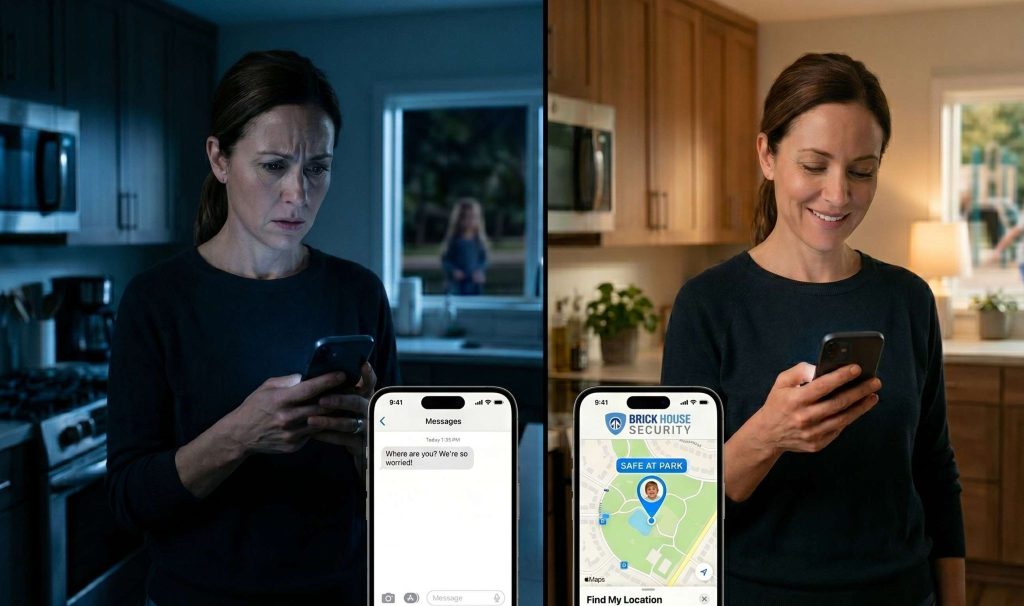
Your child is at the mall with a friend. You drop them off, wave goodbye, and drive away feeling completely fine. And then, about forty minutes later, your phone stays silent for just a little too long. You tell yourself everything is fine. You send a text. No reply. You send another. Nothing. And suddenly your brain starts doing that thing brains do, the worst kind of storytelling, in vivid detail, with absolutely no basis in reality. You are checking your phone every thirty seconds, pacing the kitchen, replaying the last conversation you had with them, wondering if you should call or if that would be embarrassing. Sound familiar? You are not alone. Not even a little bit.
A 2025 Gallup survey found that parental anxiety about child safety has now been elevated for four consecutive years, with no sign of easing. Over one in three parents report feeling genuinely unsafe about their child’s daily environment, and that number keeps climbing. The world has not necessarily become more dangerous, but the anxiety parents carry about their children absolutely has. And the cruel irony is that most of that anxiety lives in the gap between what we know and what we do not know.
A GPS tracker does not change the world. What it changes is that gap. And for a lot of parents, closing that gap changes everything.
Parents talk about their children constantly. They talk about grades, activities, friendships, screen time, and nutrition. But the specific, low-grade dread that lives underneath all of that, the quiet background fear that something could happen when you are not there, almost nobody talks about that openly.
Psychologists call this anticipatory anxiety. Your brain does not need a real threat to start reacting to one. All it needs is uncertainty, and uncertainty is exactly what every parent feels the moment their child is out of sight. A child walking to school. A teenager out with friends on a Friday night. A kid riding a bike around the neighbourhood. None of those things are dangerous. But without any information at all, the anxious brain does not know that, and spends the entire time quietly catastrophising in the background.
The exhausting part is not the fear itself. The exhausting part is trying to function normally while carrying it. Making dinner, answering emails, having a conversation with your partner, all while one part of your mind is stuck on a loop asking where your child is right now and whether they are safe.
Most parents have never experienced truly worry-free time while their child is out of the house. The closest version most of us get is distraction, keeping busy enough that the worry does not surface. But distraction and peace are completely different things.
Real peace of mind is what happens when your brain receives the information it actually needs. Not reassurance, not distraction. Actual data. Your child is at the park. Your teenager just arrived at their friend’s house. Your child’s route to school is exactly what you agreed on. The moment your brain gets that information, the catastrophising stops. Completely. Because the anxious imagination only runs wild in the absence of facts.
A GPS tracker gives your brain those facts in real time. And once parents experience that for the first time, checking an app and seeing their child’s location confirmed in seconds, most of them say the same thing. They cannot believe how much quieter their mind becomes. Not because they were paranoid before. Because information genuinely calms the nervous system in a way that blind trust simply cannot.
Yes, if you do it secretly. No, if you do it as a family agreement. And the research on this is remarkably clear.
Studies consistently show that children and teenagers who know they are being tracked and understand why do not feel surveilled. They feel supported. Many children actually report feeling more comfortable going places and trying new levels of independence precisely because they know their parents can find them in an emergency. The tracking becomes a safety net rather than a leash, and the distinction is entirely in how it is introduced.
The families that run into problems with GPS tracking are almost always the ones who install it without telling anyone, or who use it to nitpick every single stop their teenager makes rather than reserving it for genuine safety purposes. When the conversation happens first, when a parent explains clearly that the goal is safety and peace of mind, not surveillance, children accept it surprisingly well. Some even prefer it. A fourteen-year-old who knows their parents can find them in an emergency is often a fourteen-year-old who feels a little braver about the world.
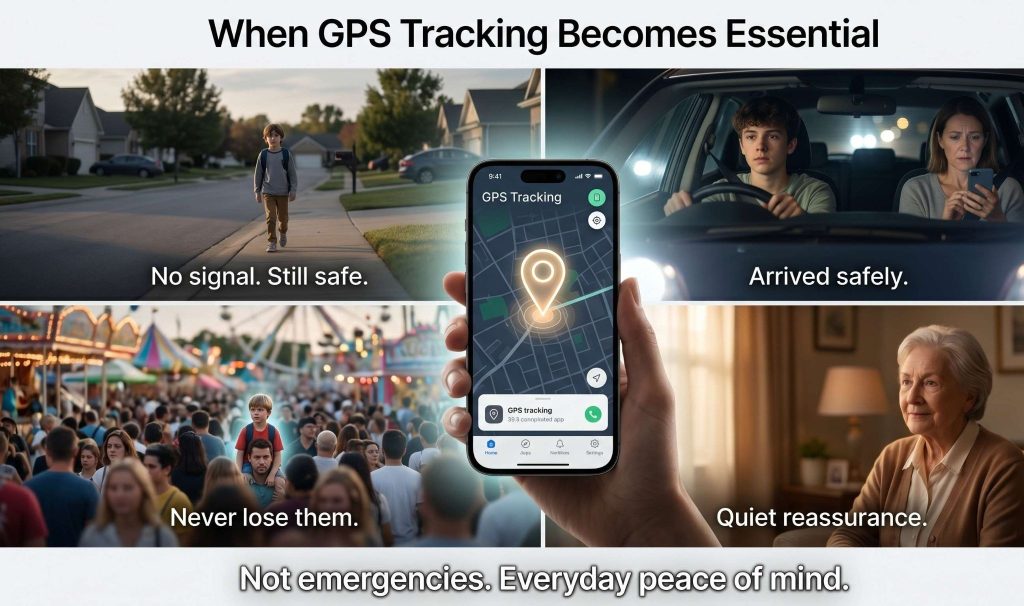
Every parent has a moment that reframes what GPS tracking actually means. Not in theory but in real life, at 10pm on a Tuesday when your teenager was supposed to be home twenty minutes ago and their phone is going straight to voicemail.
Consider a few situations where parents consistently report that GPS tracking shifted from a “nice to have” to something they cannot imagine being without:
None of these situations are dramatic. None of them involve crime or worst-case scenarios. And that is precisely the point. GPS tracking earns its value not in emergencies but in the ordinary, accumulative anxiety of everyday parenting. The daily relief of knowing your child got where they were going. The quiet moment when you check an app and immediately stop worrying. That is where the real return on this tool shows up.
Not all GPS trackers work the same way, and choosing the wrong one can create a different kind of frustration. A few things genuinely separate useful devices from ones that end up in a drawer.
Real-time updates versus delayed pings are the most important distinction. A tracker that shows location every five minutes is useful for reviewing a route after the fact. A tracker that updates every 30 seconds to two minutes is what gives you live confidence during an active outing. If peace of mind is the goal, real-time is non-negotiable.
Geofencing is the feature most parents underestimate until they use it. You draw a virtual boundary on a map, around a school, a park, a friend’s house, and your phone gets an automatic alert the moment the tracker crosses it. For parents of younger children especially, this transforms a passive awareness tool into an active safety system.
Battery life determines whether the tracker actually gets used consistently. A device that needs daily charging is a device that eventually stops being used. For children and teenagers who carry a tracker in a bag or pocket, you want something that holds charge for several days at minimum across normal usage.
For families looking for professional-grade options, BrickHouse Security has been building GPS tracking products trusted by organisations ranging from individual families to government agencies since 2005. Their range covers every family scenario, from portable personal trackers small enough for a child’s backpack to vehicle-based trackers for parents of new teen drivers, all accessible through a single, straightforward platform.
Before any device gets switched on, the conversation is the most important step. Children and teenagers receive GPS tracking completely differently depending on how it is framed, and the framing is entirely within your control as a parent.
Lead with honesty and keep it simple. Something along the lines of: “We want you to have more independence, and using a tracker means we can worry less when you are out. Your location stays between us, we are not checking it every five minutes, and as you show us you can handle more freedom, we will give it.” Most children, even teenagers who roll their eyes initially, accept that framing because it is fair. They can see the logic. You get peace of mind. They get more freedom. Everyone wins.
Agree on the rules together before the device arrives. Which situations will you check the app and which ones will you leave it alone? What happens if their battery dies and the location disappears. How long the tracking arrangement will run before you review whether it is still needed. Families that build these conversations into the rollout consistently report far less pushback than families that present GPS tracking as a unilateral decision.
For parents ready to take that first step, child GPS trackers are designed specifically for family use, compact enough that children barely notice them, durable enough for real daily use, and easy enough that the app takes minutes to learn. The goal has always been the same: give parents the information their nervous system needs so the rest of life can happen without the background noise of constant worry.
Somewhere along the way, a strange idea took hold that good parents should simply trust and not worry. That anxiety about your child’s safety is either a character flaw or evidence that you have not raised them to be independent enough. Both of those ideas are completely wrong.
Worrying about the people you love is not a weakness. The brain does not distinguish between real and imagined threats very well, and parental anxiety about child safety is one of the most universal human experiences that has ever existed. Choosing a tool that reduces that anxiety is not the same as being a helicopter parent. Knowing where your child is does not stop them from growing up. Knowing they arrived safely does not make them less capable. Watching a location pin confirm your child got home is not surveillance. For most parents, honestly, it is just breathing again.
You get to be a calm parent. You get to enjoy dinner without half your mind somewhere else. You get to sleep at night without rehearsing every possible scenario. And your child gets a parent whose anxiety is not quietly shaping every interaction they have. Everyone in the family benefits when the parent is okay. A GPS tracker, used thoughtfully and introduced honestly, is one of the simplest ways to get there.