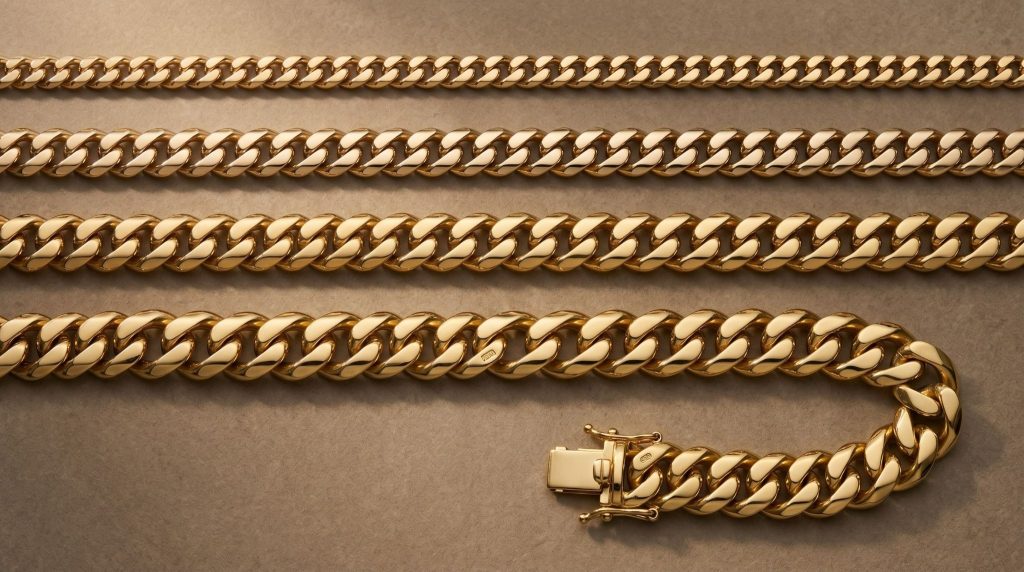
Most buyers stall the same way: thirty browser tabs, thirty chains, more confused than when they started. The fix is to stop comparing chains and start making decisions — five sequential ones, in the right order. A Cuban link chain is a stack of choices: width, karat, construction, clasp, and length. Get the order right, and the chain selects itself.
This is also how to buy a custom gold chain. The same five-step framework applies whether you walk into a Miami workshop or order online. Width × karat × construction sets the character of the chain; clasp and length determine how it lives on your body. GOLDZENN, a Miami jewelry store with over 50 years of combined workshop experience, sells handmade 7mm-and-wider links plus Italian machine-made 3-6mm imports — so the framework here carries no bias toward either tier.
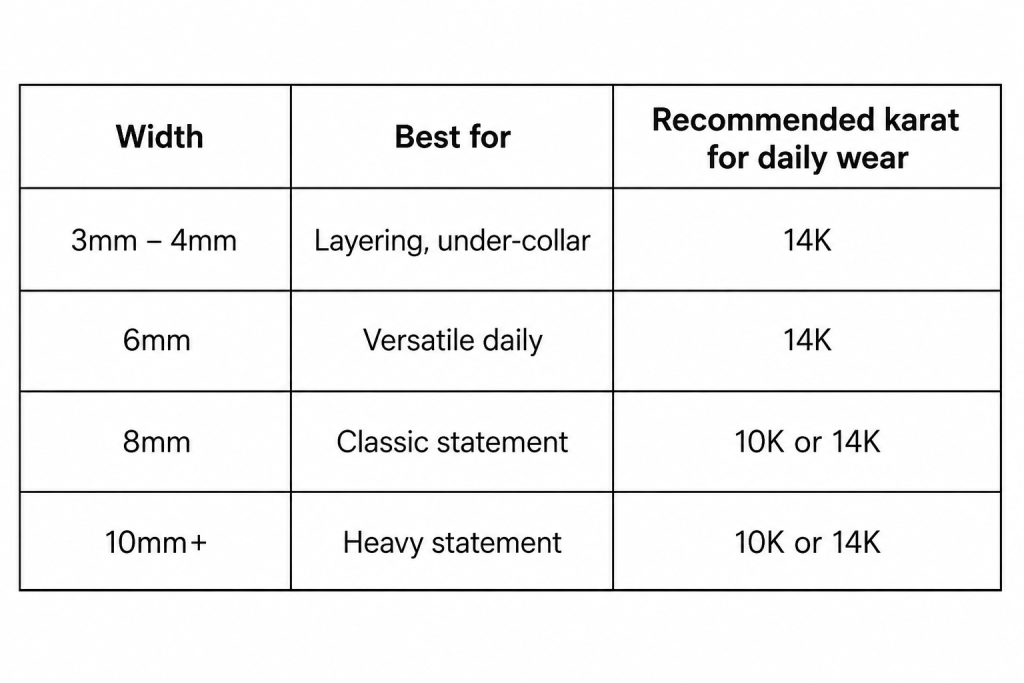
Width is the most visible attribute of a Cuban link chain and determines whether it reads as understated, balanced, or a statement.
For a chain that fits into a daily wardrobe, choose 3mm to 6mm. For one, that is the look, choose 8mm or wider.
Karat is a trade between hardness and richness. Pick the one that matches how you will wear the chain.
For a chain that takes daily abuse, choose 10K or 14K. For deepest color and more selective wear, choose 18K.
This is the step most “how to buy” guides skip, because the writer is usually selling one tier or the other. Neither is universally better.
If you want a clean, everyday chain, machine: longer is the honest answer. For a heavier statement piece or anything truly custom — special width, length, or clasp — handmade is the typical path, and fully bespoke builds outside the standard catalog run through a workshop’s custom gold jewelry projects intake.
The clasp is the least considered part of a Cuban link purchase and the part most likely to fail first.
For everyday convenience, a lobster clasp works. For 8 mm-and heavier chains, upgrade to box-with-safety.
Length controls the silhouette. Buyers often default to 24″ out of habit; that is sometimes right and sometimes wrong.
If you want one chain that works with a collared shirt and a t-shirt equally, choose 22″. If you plan to add a pendant or layer, size up to 24″ or 26″. In-store consultation pays off here — trying lengths against your neckline beats guessing from a product page. Once you have worked through widths, karats, and construction, you can explore the collection to see how each combination reads in hand.
By the time you reach the counter, you should be able to answer all five questions in one sentence: I want an 8mm 14K handmade Cuban link with a box clasp and safety latch at 22 inches. That is what a confident purchase sounds like. A good jeweler confirms the spec, weighs the piece in front of you, shows the hallmark stamp, and writes the karat and weight on the receipt.
A stock Cuban link in a standard width and length can be inspected and purchased in a single visit. A custom build — non-standard width, length, clasp, or karat — is subject to the workshop’s production schedule. The jeweler will confirm the timeline for your specific specs before starting.
For most first-time buyers, 6mm is the safe answer. It reads clearly as a Cuban link, layers well later, and works under most collars. If you already want a statement piece, jump to 8mm; for maximum versatility, stay at 4mm to 6mm.
Standard Cuban link chains are produced in a -le karat throughout — links and clasp matching. Some custom builds combine a 14K body with an 18K clasp accent, but this is a custom request, not a stock option. Confirm in writing before ordering.
Yes. Two chains of the same length crowd each other on the chest. The cleaner approach is a shorter base chain (20″–22″) plus a longer second chain (24″–26″), so each finds its own line.
Three checks: a karat hallmark stamp on the clasp or end link (10K, 14K, 417, 585), a weight that matches the declared width and length on a calibrated scale, and a written receipt naming the karat and weight. A reputable jeweler does all three in front of you without being asked.
No. Machine-made Cuban links in the 3mm to 6mm range are often the smarter buy for daily wear — tighter tolerances, more uniform finish. Handmade earns its premium at 7mm and above, where weight and cus and aom geometry matter, and hand-soldering is visible in the finished piece.