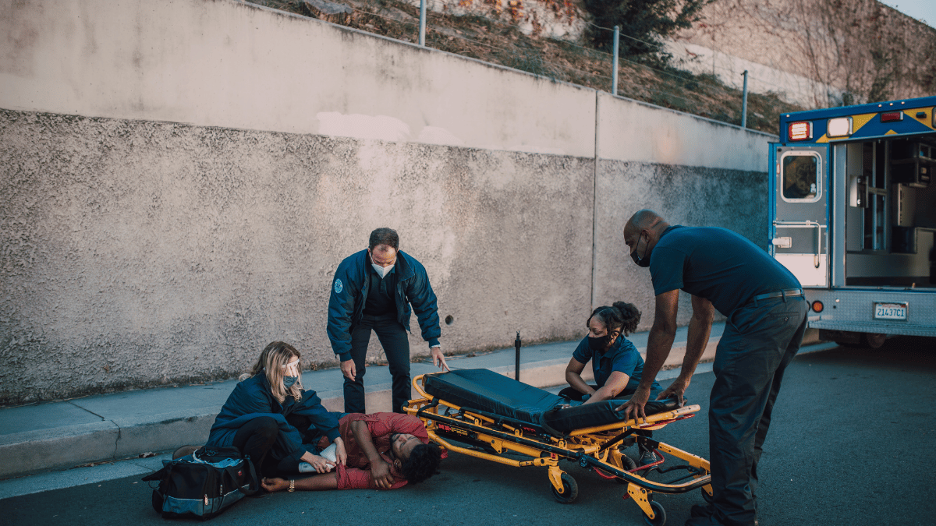
When people picture an emergency response, they picture professionals: the ambulance, the flashing lights, the trained crew. But in the seconds and minutes that most often decide an outcome, none of them have arrived yet. The first responder to almost any emergency is whoever happens to be standing there, a coworker, a stranger, a family member. What that person does, or fails to do, frequently matters more than anything that comes later.
That reality sits at the heart of a concept emergency medicine calls the chain of survival: a sequence of actions where each link depends on the one before it. The chain begins not with a paramedic but with a bystander who recognizes the emergency and acts.
For sudden cardiac arrest, the math is stark. According to the American Heart Association, immediate CPR can double or even triple a person’s chance of survival, yet many victims do not receive it because bystanders hesitate. For severe bleeding, the window is even shorter. The interventions that close these gaps are simple, but they only work if someone starts them right away.
Study after study finds that people often freeze in an emergency, not from cowardice but from uncertainty and the assumption that someone else will step in. The antidote is preparation. People who have taken even a short course, and who have decided in advance that they will act, are far more likely to move when it counts.
Trauma surgeon and EMS physician Dr. Alexander Eastman, who helped shape the framework behind the national Stop the Bleed campaign, has spent much of his career on exactly this idea: pushing capability toward the public so that ordinary people are equipped to bridge the gap until professionals arrive. It is the same logic that put automated external defibrillators in airports and offices, and that now places bleeding-control kits alongside them.
The takeaway is not that everyone must become a medic. It is that a small amount of preparation, a CPR class, a bleeding-control course, a decision made ahead of time, turns an ordinary person into a functioning first link in the chain. The professionals still matter enormously. But they inherit whatever the first few minutes leave them, and those minutes belong to whoever is there.
For those who want to be ready, the American Heart Association offers CPR training in most communities.