The agrimony vs hemp agrimony question matters when you are checking a plant, tea, extract, or supplement before buying it. The names sound related, but they identify two botanically different plants. This guide shows you which names, plant families, flowers, leaves, and label details to check. HerbEra takes the position that the botanical name should decide the identification, never the shared word in the common name.
The short answer is no. Agrimony usually means Agrimonia eupatoria, a member of the rose family. Hemp agrimony means Eupatorium cannabinum, a member of the daisy family. They do not belong to the same genus or family, and buyers should not regard them as interchangeable ingredients.
No. True agrimony and hemp agrimony are separate species with different botanical identities. The word “agrimony” in both English names does not make them equivalent.
Common agrimony belongs to the genus Agrimonia and the family Rosaceae. Hemp agrimony belongs to the genus Eupatorium and the family Asteraceae. That gap is larger than a difference between two varieties of the same herb.
| Identification point | Agrimony | Hemp agrimony |
|---|---|---|
| Accepted botanical name | Agrimonia eupatoria L. | Eupatorium cannabinum L. |
| Plant family | Rosaceae, the rose family | Asteraceae, the daisy family |
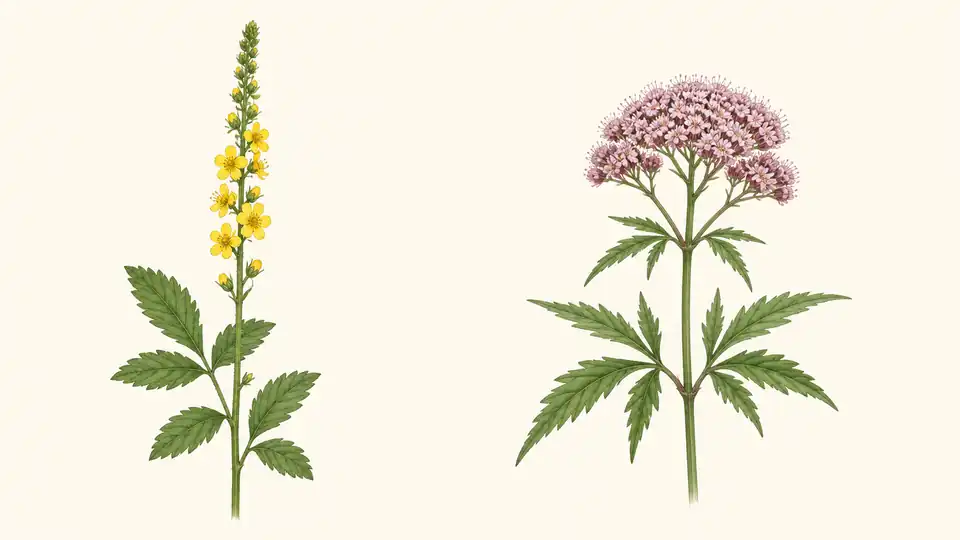
| Typical flowers | Small yellow, five-petaled flowers on a slender spike | Tiny light pink or purple florets in dense, domed clusters |
| Leaves | Pinnate, deeply veined, and hairy | Opposite, toothed, and often divided into three or five narrow segments |
| General habit | Upright herb with narrow flower spikes | Taller, clump-forming perennial with branching flower heads |
| Typical setting | Grassy places, verges, hedgerows, and well-drained ground | Damp ground, wet margins, ditches, and moist woodland edges |
| Commercial plant part | Often the flowering aerial parts, also called the herb | Must be stated for the specific material, such as aerial parts, leaf, or root |
| Clear label example | Agrimony (Agrimonia eupatoria) (flowering aerial parts) | Hemp agrimony (Eupatorium cannabinum) (aerial parts) |
| Interchangeable | No | No |
| Related to Cannabis sativa | No | No |
The label examples show clear identification, not a universal formula for every market. The stated plant part must match the material inside the product.
Common plant names preserve old observations and naming habits. They do not reliably show botanical relationships.
The “hemp” part of hemp agrimony refers to the plant’s divided leaves, which can look somewhat like hemp leaves. It does not mean the plant is hemp, marijuana, or a source of CBD. Eupatorium cannabinum and Cannabis sativa belong to different plant families.
The “agrimony” part is also misleading. Historical naming linked hemp agrimony with true agrimony even though modern taxonomy places them far apart.
This is why a front label that says only “agrimony” deserves a closer look. It may refer to Agrimonia eupatoria, another Agrimonia species, or a poorly identified product. A binomial removes much of that uncertainty.
Start with the flowers. Agrimony produces a narrow spike of small, five-petaled yellow flowers. Hemp agrimony produces domed clusters of tiny florets that are commonly light pink or purple, although paler forms occur.
Next, examine the leaves. Agrimony has pinnate leaves with alternating larger and smaller leaflets. It looks slim and vertical in flower. Hemp agrimony has opposite leaves divided into narrow, toothed segments and usually forms a broader, taller clump.
Habitat can support an identification, but it cannot prove one. Agrimony often grows in grassy, relatively well-drained sites. Hemp agrimony commonly favors moist or poorly drained ground. A plant in an unusual site can still occur, so use habitat only as a supporting clue.
Do not identify material for ingestion from one photograph or an app alone. Dried and powdered herbs lose visible features, so supplier documentation and identity testing matter more.
Look for three linked details: the common name, the complete botanical name, and the plant part. Together, they tell you far more than a large product name on the front panel.
For agrimony, a clear declaration may read “Agrimony (Agrimonia eupatoria) (flowering aerial parts).” For hemp agrimony, it should state Eupatorium cannabinum and the actual part used. “Agrimony extract” without a species and plant part is too vague for confident identification.
In the United States, dietary supplement labeling rules require the plant part for a botanical dietary ingredient. The Latin binomial is required in some naming situations. Clear manufacturers often provide it even when a standardized common name is recognized. Rules differ by country, so a well-written label is useful but does not by itself establish legal compliance everywhere.
HerbEra’s editorial standard is straightforward: when a seller cannot confirm the species and plant part, the buyer should not guess from marketing copy or package imagery. Ask for the missing details or choose a better documented product.
A Latin name confirms what the seller declares, not what laboratory testing found. If you request a certificate of analysis, check that its lot number matches the product and that it reports an identity test. A generic sheet with no matching batch details has limited value.
No. Do not replace agrimony with hemp agrimony in a supplement, tea, extract, formula, or botanical specification. A shared common-name fragment is not a basis for substitution.
This distinction also has a safety dimension. The American Herbal Products Association lists Eupatorium cannabinum among botanicals that contain toxic pyrrolizidine alkaloids. Its trade requirements say products containing such ingredients should not be offered for internal use by members and specify cautionary labeling for external use. That industry rule is not a universal law, but it is a serious reason not to assume hemp agrimony has the same use profile as agrimony.
If you are considering any herbal supplement, review the exact ingredient with a qualified health professional or pharmacist, especially during pregnancy, while nursing, when taking medication, or when managing a liver condition. Do not consume a wild plant based only on a common name or online image.
Use this checklist before purchasing a loose herb, powder, capsule, tincture, or extract. It focuses on identity, not promised effects. A product should pass every relevant check without requiring you to infer what is inside.
Look for Agrimonia eupatoria when you want common agrimony and Eupatorium cannabinum when the product is hemp agrimony. Do not rely on “agrimony” alone.
Make sure the common name agrees with the binomial. A mismatch is a reason to stop and ask the seller for clarification.
Check whether the label states flowering aerial parts, leaf, root, or another part. The wording should describe the material actually used.
Note whether the ingredient is whole, cut, powdered, or extracted. Visual comparison becomes less useful as processing increases.
If documentation is available, confirm that the product name and lot number match. Look for evidence of identity testing, not only general quality tests.
Do not accept one plant as a substitute for the other. Neither the shared name nor similar-looking leaves makes the ingredients interchangeable.
Ask the seller to confirm the species and plant part in writing. If the answer remains unclear, choose a better documented option.
No. Hemp agrimony is Eupatorium cannabinum in the Asteraceae family. Common agrimony is Agrimonia eupatoria in the Rosaceae family.
No. Hemp agrimony is not Cannabis sativa. Its name refers to the hemp-like appearance of its divided leaves.
Agrimony has small yellow flowers along a narrow spike. Hemp agrimony has dense, domed clusters of tiny pink or purple florets.
If the intended species is common agrimony, look for Agrimonia eupatoria. A label should also identify the plant part used.
Hemp agrimony is Eupatorium cannabinum. The label should not present it as Agrimonia eupatoria or Cannabis sativa.
No. They are different species from different plant families and should not replace each other in products or formulas.
The common name does not indicate CBD or cannabis content. Hemp agrimony is not botanically related to Cannabis sativa.
No. It confirms what the seller declares, but not the contents by itself. Also check the plant part, lot details, and identity documentation.
Accepted botanical name
The scientific name currently recognized by a taxonomic authority for a plant.
Aerial parts
The portions that grow above ground, usually stems, leaves, and flowers.
Asteraceae
The daisy family, which includes hemp agrimony.
Binomial
A two-part scientific name made from the genus and species, such as Agrimonia eupatoria.
Common name
An everyday plant name that can vary by region and may refer to more than one species.
Floret
One small flower within a clustered flower head, common in the Asteraceae family.
Plant part
The specific botanical material used, such as leaf, root, flower, or aerial parts.
Rosaceae
The rose family, which includes common agrimony.
Species authentication
The process used to confirm that botanical material matches its declared species.
Agrimony and hemp agrimony are not the same herb and are not suitable substitutes. Check the binomial and plant part before buying: Agrimonia eupatoria identifies common agrimony, while Eupatorium cannabinum identifies hemp agrimony.