Losing a tooth can happen for many reasons, from decay and gum disease to sports injuries and accidents. Whatever the cause, a gap in your smile can affect how you eat, speak and feel about your appearance. Leaving a gap untreated can also lead to neighbouring teeth drifting over time. If you’re exploring dental bridges melbourne clinics provide, you’ve probably also heard about dental implants. Both are well-established options, and understanding how they compare can help you have a more informed conversation with your dentist.
This article offers general information only. Your dentist will assess your oral health and explain which options suit your situation.
A missing tooth isn’t just a cosmetic concern. The teeth on either side of a gap may gradually tilt or shift into the space, and the opposing tooth in the other jaw may move up or down. These changes can affect your bite and make cleaning more difficult, potentially increasing the risk of decay and gum disease.
Over time, the jawbone in the area of a missing tooth can also shrink because it’s no longer being stimulated by a tooth root. This can affect future treatment options and, in some cases, facial appearance.
A dental bridge fills a gap by attaching an artificial tooth to the teeth on either side. The most common type is a traditional bridge, where the neighbouring teeth are prepared and fitted with crowns that support the replacement tooth between them.
Bridges are a long-established treatment and don’t require surgery. Treatment is usually completed over a couple of appointments, making it a relatively quick way to restore your smile. A bridge can also be a good option if the neighbouring teeth already have large fillings or would benefit from crowns.
Preparing the neighbouring teeth involves removing some of their natural structure, which is generally irreversible. Cleaning under a bridge requires extra care, using tools such as floss threaders or interdental brushes. Bridges also don’t replace the tooth root, so they don’t prevent bone loss in the gap.
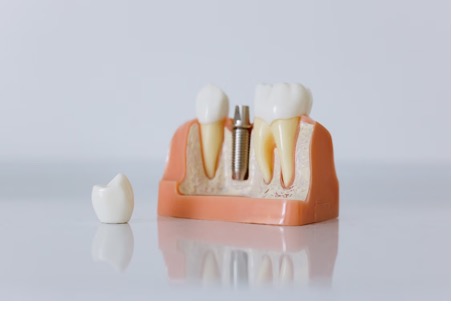
A dental implant replaces the root of a missing tooth with a small titanium or similar post placed in the jawbone. Once the implant has integrated with the bone, a crown is attached to it.
Implants stand independently, so the neighbouring teeth don’t need to be altered. Because the implant replaces the root, it may help maintain bone in the area. Many people find implants feel similar to natural teeth, and they’re cleaned in much the same way.
Implants involve a surgical procedure and typically take longer from start to finish, as the bone needs time to heal around the implant. Not everyone is a suitable candidate. Factors such as the amount of available bone, gum health, smoking and some medical conditions can affect suitability. Implants also tend to involve a higher upfront cost than bridges.
When deciding between a bridge and an implant, your dentist will consider the health of the neighbouring teeth, the condition of your gums and jawbone, your general health and medications, your budget and timeframe, and your personal preferences.
For example, if the teeth next to the gap are healthy and free of fillings, an implant may avoid the need to alter them. If those teeth already need crowns, a bridge may make sense. If bone levels are low, additional procedures may be required before an implant can be placed.
Being prepared with questions can help you feel confident in your decision. Ask what options are suitable for your situation, how long each treatment takes, what the full costs are, how long each option is likely to last with good care, what the risks and limitations are, and what maintenance will be involved. The Australian Dental Association provides helpful general information about tooth replacement options.
Whichever option you choose, good oral hygiene is essential. Brush twice daily, clean between your teeth carefully and attend regular check-ups and cleans. Your dentist or hygienist can show you the best techniques and tools for keeping your bridge or implant clean.
Bridges and implants aren’t the only ways to replace a missing tooth. A removable partial denture can be a more affordable option, particularly when several teeth are missing in different parts of the mouth. Resin-bonded bridges, which attach to the back of neighbouring teeth with minimal preparation, may also be suitable in certain situations. In some cases, a bridge supported by implants rather than natural teeth can replace several missing teeth in a row. Your dentist can explain whether any of these alternatives suit your needs, along with their benefits, limitations and costs, so you can compare all the options available to you.
Cost, time and comfort all matter, but so does your long-term oral health. A thorough assessment, including X-rays or scans where needed, gives your dentist the information they need to recommend options that will serve you well into the future.
Bridges and implants both offer effective ways to replace a missing tooth, but they work differently and suit different situations. Understanding the potential benefits and trade-offs of each will help you work with your dentist to choose a solution that supports your oral health, comfort and confidence for years to come.