Almost every research peptide vendor says it has a certificate of analysis (COA). Far fewer buyers know what to look for once they open one. A COA is a dense, one-page lab report full of acronyms, decimals, and a squiggly graph, and it’s easy to glance at the purity number and move on.
Blends make this harder. A multi-peptide blend puts several compounds in one vial, and the lab reports on all of them in a single run. One chromatogram has to account for every component. One purity figure covers the whole sample. Each component’s amount is then reported on its own line.
This guide walks through a real blend COA line by line, so you can check five things yourself: that the report matches your vial, that the compounds are what the label says, how pure the sample is, whether each component is present in the labeled amount, and whether the lab behind it is credible.
A quick note on scope: the products discussed here are sold for research use only. This article is about reading documentation, not about what any compound does or how it might be used.
A certificate of analysis is a laboratory’s report on one tested sample taken from a specific production batch. It records which tests were run, which methods were used, and what the results were.
Who runs the test matters as much as the result. An in-house COA comes from the manufacturer’s or vendor’s own lab. A third-party COA comes from an independent lab with no stake in whether the product passes. Independent testing removes the most obvious conflict of interest, which is why most careful buyers look for it first.
The next question is whether that lab is competent. The main benchmark is ISO/IEC 17025, the international standard for the competence, impartiality, and consistent operation of testing and calibration labs. An accredited lab has been audited by an accreditation body against that standard.
There is a catch that many buyers miss. Accreditation is granted for a defined scope: specific tests, on specific types of samples, using specific methods. A lab can be ISO 17025 accredited and still run a test that isn’t on its scope. As QBench’s ISO 17025 overview explains, the scope document is what tells you which results the accreditation actually covers.
Start at the top of the report. The header ties the results to one physical sample, and if it doesn’t match what you have, nothing below it applies to your vial.
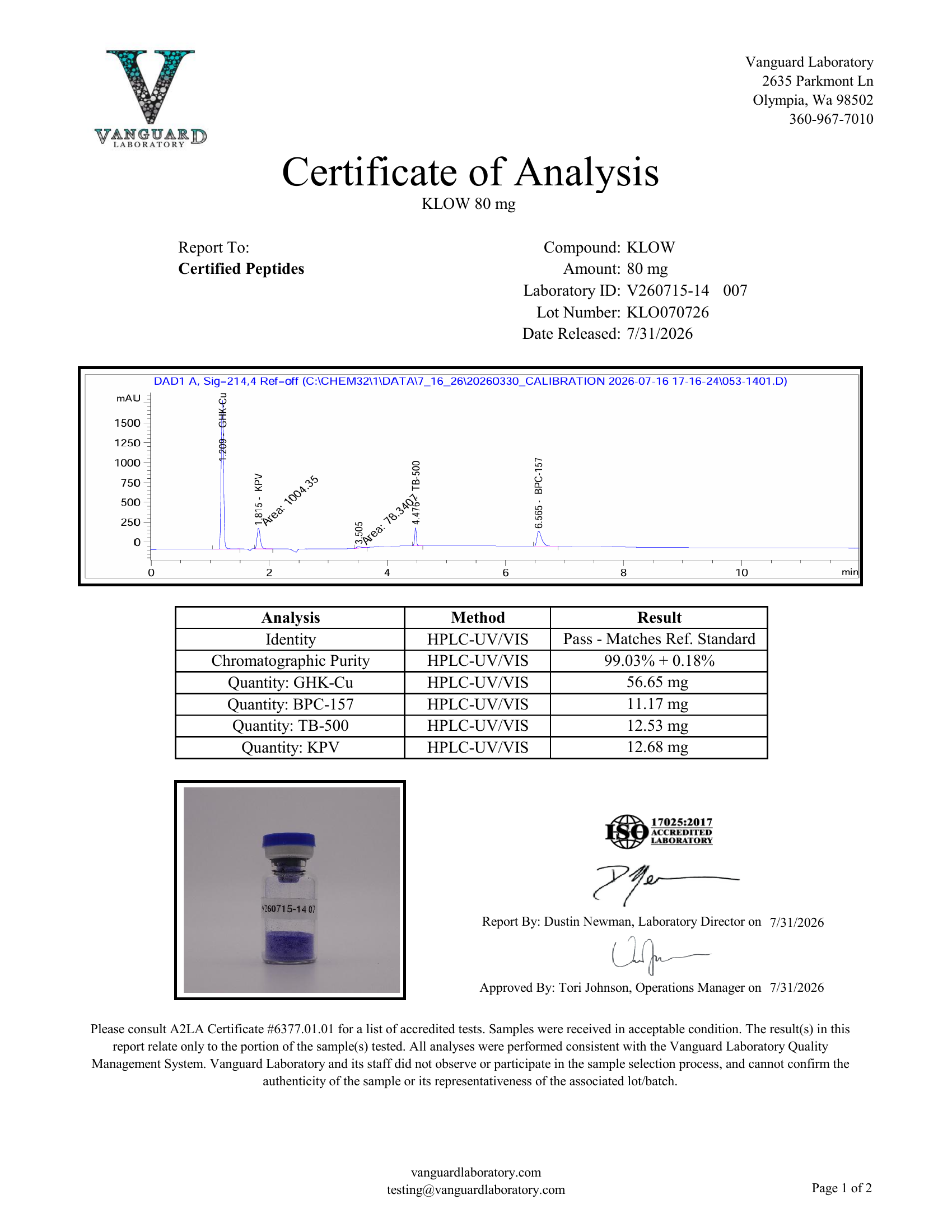
Our worked example is a COA for KLOW, an 80 mg blend of four peptides, issued by Vanguard Laboratory in Olympia, WA.
Its header lists:
The single most useful check is simple: the lot number on the COA should match the lot number printed on your vial. The KLOW report also includes a photo of the tested vial with the lab ID visible, which links the paperwork to a physical sample.
Red flags in the header:
The graph on a peptide COA is a chromatogram, produced by high-performance liquid chromatography (HPLC). HPLC pushes a dissolved sample through a packed column. Different compounds travel through it at different speeds, so they exit at different times. A detector records each compound as it comes out, and each one shows up as a peak.
The time it takes a compound to exit is its retention time, measured in minutes from injection. Under the same conditions, a given compound comes out at a consistent retention time, which is what makes the graph readable.
For a single peptide, you expect one dominant peak. For a blend, you should see one main peak for each component. The KLOW chromatogram shows four labeled peaks at distinct retention times:
| Peak order | Component | Retention time (min) |
| 1 | GHK-Cu | 1.209 |
| 2 | KPV | 1.815 |
| 3 | TB-500 | 4.476 |
| 4 | BPC-157 | 6.555 |
The four peaks are well separated, so each component can be identified and measured on its own.
Peak height and area relate to how much of a compound passed the detector, though the detector’s response also varies from one compound to another. On this COA, GHK-Cu produces the tallest peak, which fits with it being the largest component in the blend at 50 mg of the 80 mg total.
You may also see small, unlabeled bumps along the baseline. These are usually minor impurities or trace related substances. They matter because they feed directly into the purity figure covered below.
[VISUAL: annotated screenshot of the KLOW chromatogram with a callout on each of the four peaks. CONFIRM image rights and redaction of signatures with client before publishing.]
Identity testing answers the most basic question: are the compounds in the vial the ones named on the label? On the KLOW COA, identity was tested by HPLC-UV/VIS, and the result reads “Pass – Matches Ref. Standard.”
A reference standard is a well-characterized sample of a known compound that the lab uses as a benchmark. In retention-time matching, the lab runs the reference standard and the test sample under the same conditions. If the sample’s peaks appear at the same retention times as the standard’s, the identity test passes.
Mass spectrometry (MS) is a different identity method. It measures the molecular weight of what’s in the sample and compares it to the expected weight of the target compound. Retention-time matching and MS confirm identity in different ways, and some vendors report both. When you read a COA, note which method was used, since the report will name it next to the result. The KLOW COA reports HPLC-based identity against a reference standard.
Chromatographic purity is the share of the total peak area that belongs to the target compounds. If the four labeled peaks make up 99% of all the area under the curve, and small impurity peaks make up the other 1%, the sample is reported at 99% purity.
The KLOW COA reports chromatographic purity by HPLC-UV/VIS of 99.03% ± 0.18%.
The ± figure is the measurement uncertainty. No measurement is perfectly exact, and ISO 17025 requires accredited labs to evaluate the uncertainty of their results. Here, it means the lab’s best estimate is 99.03%, with the true value expected to fall within about 0.18 percentage points either way. A COA that reports purity with uncertainty is giving you more information than one that prints a bare number.
On a blend, there’s an important limit to this number. One purity figure covers the whole run. It tells you how little of the sample is something other than the four target peptides. It does not tell you whether those four are present in the right proportions. A vial could be very pure and still be short on one component. That’s what the quantity lines are for.
This is the section that makes a blend COA different from a single-peptide one. Instead of one quantity, you get a measured amount for every component, and each one should be checked against its labeled amount.
For example, the COA for the KLOW 80mg peptide blend reports a separate measured quantity for each of its four components, which makes it easy to compare against the label:
| Component | Label (mg) | Measured (mg) | Measured as % of label |
| GHK-Cu | 50 | 56.65 | 113% |
| BPC-157 | 10 | 11.17 | 112% |
| TB-500 | 10 | 12.53 | 125% |
| KPV | 10 | 12.68 | 127% |
Every component comes in above its labeled amount. Some overfill is common in peptide manufacturing, because producers aim to guarantee the vial holds at least what the label says. Underfill is the bigger red flag. A measured amount below the label means you’re getting less of that component than stated.
The second check is the ratio. The label calls for a 5:1:1:1 split, with GHK-Cu at five times each of the others. On the COA, GHK-Cu measures roughly 4.5 to 5 times each of the other three components, so the overall proportions are close to the labeled formula. When you read any blend COA, look for both things: each component at or above its label, and no single component wildly out of line with the rest.
A COA is only as trustworthy as the lab that issued it. Look for three things:
The KLOW COA names Vanguard Laboratory in Olympia, WA. The report was prepared by Dustin Newman, Laboratory Director, and approved by Tori Johnson, Operations Manager. It carries the ISO 17025:2017 logo and directs readers to “consult A2LA Certificate #6377.01.01 for a list of accredited tests.”
That last line is the one to act on. A2LA (the American Association for Laboratory Accreditation) publishes certificates and scope documents for the labs it accredits. You can look up Vanguard’s A2LA certificate and scope, confirm it is current (at the time of writing it is listed as valid through September 30, 2027), and check whether the tests on your COA appear on the scope.
Some labs also offer online COA verification, which lets you confirm that a report is genuine and unaltered. Vanguard runs a “Verified by Vanguard” lookup for this purpose. [CONFIRM whether lot KLO070726 is listed; if so, add: “The KLOW report can be checked there using its laboratory ID.”]
A good COA is strong evidence, but it has limits, and reputable labs state them. The KLOW COA includes a disclaimer that its results apply only to the sample tested. The lab did not observe how that sample was selected, so it can’t confirm the sample represents the full lot.
In practice, that means a COA tells you about one vial from a batch. It’s still far better than no testing, and it’s why batch-specific COAs matter more than a single report reused across many batches.
A COA also covers only the tests that were run. A purity and quantity report does not tell you anything about:
unless those panels are listed on the report. Check the test list rather than assuming. Note the page count too. If a COA says “Page 1 of 2,” ask the vendor for the full report, since additional pages may include other panels or notes. [CONFIRM contents of KLOW COA page 2; if it includes endotoxin, sterility, or heavy metals results, mention them here.]
HPLC can confirm identity against a reference standard, measure purity, and quantify each component, which covers the core questions most buyers have. It identifies compounds by comparing retention times, while mass spectrometry confirms molecular weight. Some vendors report both for extra confirmation. HPLC alone does not test for sterility, endotoxins, or heavy metals, so check whether those panels were run if they matter for your work.
Many research peptide vendors target 98% or higher chromatographic purity, and results above 99% are common on third-party reports. The number alone isn’t the full picture, though. Check that it comes with a measurement uncertainty, that identity passed, and, for a blend, that each component’s quantity matches the label. A high purity figure doesn’t confirm the right proportions on its own.
Producers often overfill vials slightly so that every vial contains at least the labeled amount, even allowing for small losses during filling and handling. Measured amounts somewhat above the label are normal. What deserves a closer look is any component measuring below its label, or one component far out of proportion to the others in a blend.
Often, yes. Some labs run online lookups where you enter the laboratory ID or a verification code to confirm the report is authentic. If no lookup exists, you can contact the lab with the lab ID and lot number. You can also check the lab’s accreditation status and scope through its accreditation body, such as A2LA.
A blend COA asks more of its reader than a single-peptide report, but the logic is the same. Match the lot to your vial. Confirm the lab is independent and accredited for the tests it ran. Check that identity passed, that the chromatogram shows every component, and that purity comes with an uncertainty. Then compare each component’s measured quantity to its label, and read the disclaimer for what the report doesn’t cover. Before you buy, ask for a batch-specific COA for the exact lot you’ll receive. A vendor confident in its testing should be able to provide one.