There is almost certainly lithium within arm’s reach of you right now. Your phone, your laptop, your wireless earbuds, the cordless drill in the garage, all of them run on lithium-ion batteries. Even if you drive an electric vehicle, or know someone who does, the battery pack making that possible holds more lithium than 10,000 smartphones combined. And yet, for a material this deeply woven into daily life, most people have almost no idea where lithium actually comes from, or what a long and strange journey it takes to get from the ground into the devices we check before bed every night.
So, where does it come from?
The short answer is: mostly from underground lakes of saltwater, called brines, buried beneath some of the most remote desert landscapes on Earth. The longer answer is a lot more interesting.
Lithium is the lightest solid element on the periodic table, light enough to float on water, soft enough to cut with a kitchen knife. It was first discovered in 1817 inside a mineral found on a Swedish island, and for most of the following century it was used mainly in ceramics, glass, and psychiatric medication. Lithium carbonate is still prescribed today for bipolar disorder. The element that stabilizes mood also, apparently, stabilizes battery chemistry, and when engineers started developing rechargeable batteries in the 1980s and 1990s, lithium turned out to be exceptional at holding and releasing electrical charge repeatedly without degrading.
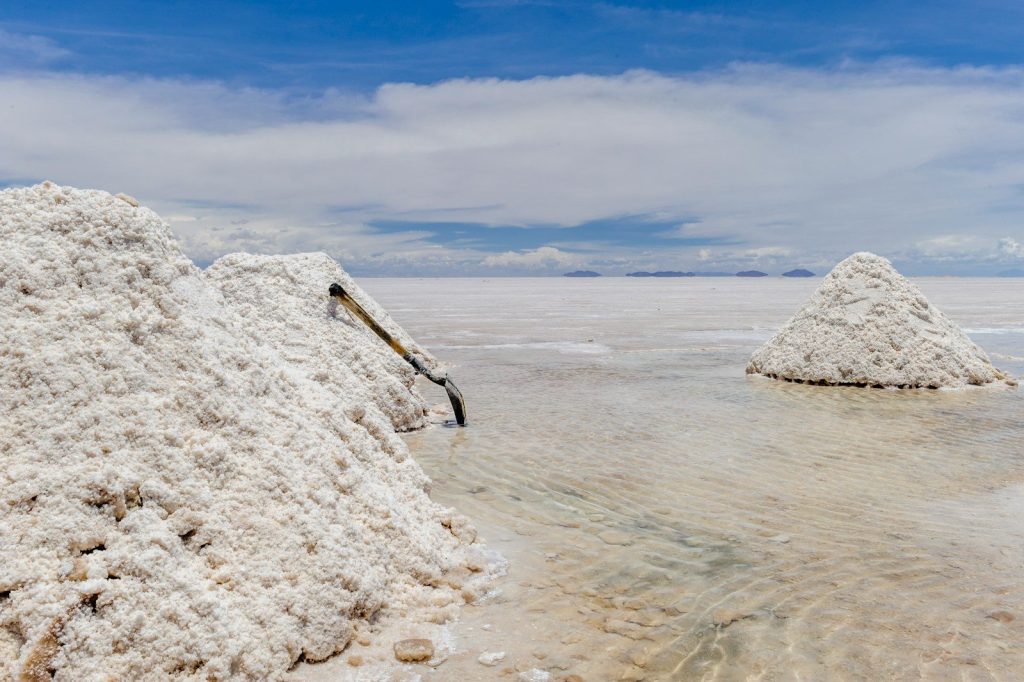
The conventional way to extract lithium from brine involves pumping that underground saltwater up into enormous evaporation ponds spread across the desert. The sun does most of the work, slowly reducing the water until the lithium concentrates enough to be processed. It takes anywhere from 12 to 18 months for a single cycle, and the process typically recovers only about 40 to 50 percent of the lithium present in the original brine. This is how the majority of the world’s lithium supply has been produced for decades, in the salt flats of Chile and Argentina primarily, where the ponds can stretch for kilometers under an almost vertical sun.
More recently, a different approach has been gaining traction. Instead of waiting for evaporation, some companies have developed technologies that pull lithium directly out of brine using selective membranes, chemical adsorbents, or solvent-based systems. The process takes days rather than months and recovers a much higher proportion of available lithium with considerably less freshwater use.
EnergyX, a company based in Austin, Texas, has been working on one such platform, called GET-LiT, which combines several of these approaches to handle different types of brine. They hold over 120 patents on extraction and processing methods, and have received a $5 million grant from the US Department of Energy to advance lithium extraction from geothermal brines. The fact that federal energy agencies are funding this kind of research gives a sense of how seriously the supply question is being taken at a policy level.
The geography of where lithium is found is fascinating on its own. The largest known reserves sit in a region of South America called the Lithium Triangle, covering parts of Chile, Argentina, and Bolivia. The landscape there is extraordinary, ancient lake beds that dried out over millions of years and left behind concentrated mineral deposits beneath a crust of white salt. The Salar de Atacama in Chile is one of the most productive brine operations in the world, sitting at over 2,300 meters elevation, dry and cold at night and intensely sunny during the day. Roughly a quarter of all global lithium production comes from Chile alone.
Lithium also exists in hard rock form, particularly in a mineral called spodumene found in Australia, which is the other major producing country. Hard rock mining is more familiar in method, similar to other types of open-pit or underground mining, but it requires more energy-intensive processing to get from raw ore to usable lithium compounds. According to the US Geological Survey’s mineral resources data, worldwide lithium resources are substantial, well above what would be needed to meet demand through the end of this century, but how and where those resources are extracted matters enormously for the environmental and geopolitical picture.
The United States has its own lithium resources. There is brine production in Nevada, and significant deposits have been identified in other states including Arkansas, where the underground brine in the Smackover formation has attracted serious exploration interest. Building out domestic extraction capacity has become a priority for the US government, partly because so much of the current processing capacity sits in China, which refines a dominant share of the world’s lithium even when it is mined elsewhere.
For anyone who has ever looked at the tiny percentage of the global EV market that has been achieved so far and then tried to imagine what happens when that percentage becomes 30 or 40 percent, the supply chain question starts to look quite pressing. Batteries need lithium. More batteries mean more lithium. The production process, where it happens and how, will shape a lot of what that transition actually looks like in practice.
What is perhaps most striking when you look at all of this is how something so specific, a soft silvery metal that most people could not pick out of a lineup, sits at the intersection of climate, geopolitics, technology, and daily life in a way that almost no other material does. The next time you charge your phone, there is a small, real story behind the charge.