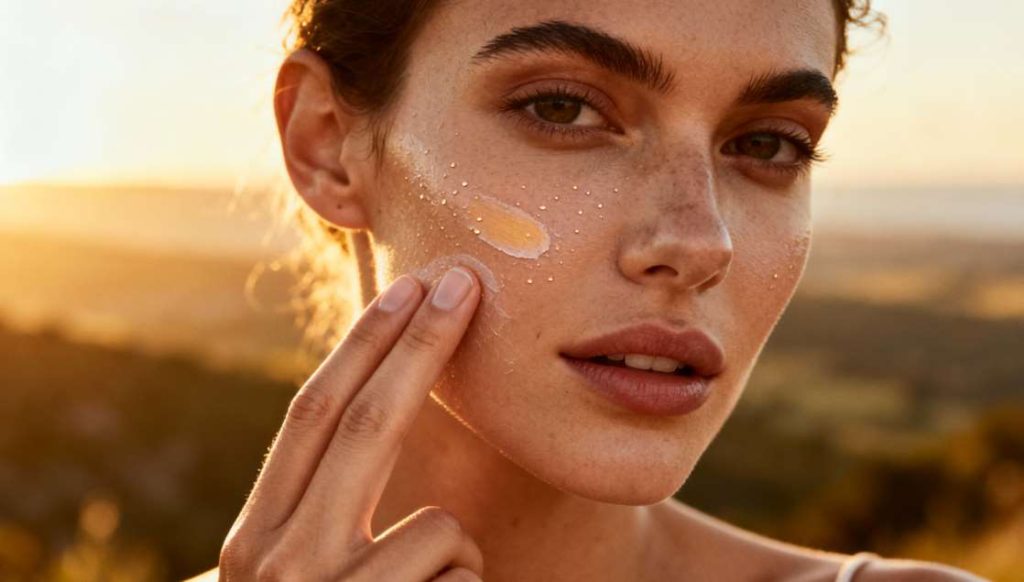
Dermatologists have spent decades convincing people to wear daily sunscreen. The message finally landed. SPF is non-negotiable for skin health. But for those with chronically dry skin, this victory came with an unintended consequence: many sunscreen formulations actively worsen the very condition they’re meant to protect.
The irony is significant. You commit to daily sun protection, diligently applying SPF every morning. Your skin responds by becoming drier, flakier, and more irritated. Eventually you face an impossible choice: protect your skin from UV damage or protect it from the product meant to provide that protection.
This isn’t a rare experience. Search “sunscreen makes my skin dry” and you’ll find thousands of frustrated posts from people who developed dry patches, tightness, or outright peeling after consistent sunscreen use. The problem isn’t sunscreen itself. It’s how most formulations are designed.
Pick up a conventional sunscreen and check the ingredients. Chances are high that alcohol (often listed as “alcohol denat” or “SD alcohol“) appears in the first five ingredients.
Manufacturers add alcohol for legitimate reasons. It creates a lightweight texture, helps the product dry quickly, and eliminates the greasy feeling many people associate with sunscreen. For oily or acne-prone skin, alcohol-based formulations can work well.
For dry skin, alcohol is catastrophic. It strips the skin’s lipid barrier, the protective layer of oils and ceramides that prevents water loss. Within minutes of application, transepidermal water loss increases. Your skin literally loses moisture faster than it can retain it.
The effect compounds over time. Daily alcohol exposure progressively damages the barrier. Skin that started slightly dry becomes severely compromised, leading to sensitivity, inflammation, and that tight, uncomfortable feeling that persists all day.
Some sunscreens contain up to 80% alcohol. You’re essentially applying rubbing alcohol to your face every morning, wondering why moisturizer no longer seems to work.
Many alcohol-free sunscreens solve the texture problem differently: silicones. Ingredients like dimethicone, cyclopentasiloxane, and cyclomethicone create that smooth, velvety feel consumers expect from modern sunscreen.
Silicones aren’t inherently bad. They’re inert, generally non-irritating, and create an effective barrier against environmental damage. For normal or oily skin, they work well.
But silicones are occlusive. They form a seal on the skin’s surface. For already-dry skin, this can trap dryness underneath rather than allowing moisture to penetrate. You’ve essentially wrapped your dehydrated skin in plastic wrap.
The situation worsens when you layer products. Silicone-based sunscreen over silicone-based primer over silicone-based moisturizer creates multiple occlusive layers. Nothing hydrating reaches your skin. Everything sits on top, eventually pilling or balling up as you apply makeup.
Beyond base formulation issues, chemical sunscreen filters themselves can irritate dry skin.
Ingredients like avobenzone, octinoxate, and oxybenzone work by absorbing UV radiation and converting it to heat. For intact, healthy skin, this process is generally well-tolerated. For compromised skin barriers (the reality for chronically dry skin), these filters can trigger sensitivity reactions.
The heat conversion process, while minimal, can increase transepidermal water loss. You’re already fighting moisture depletion from damaged barriers. Adding a heat-generating chemical accelerates the problem.
Some chemical filters also have slight penetrating capabilities. When skin barriers are compromised, penetration increases, leading to irritation that wouldn’t occur with healthy skin. The result is a cycle: sunscreen irritates dry skin, which compromises barriers further, which makes sunscreen more irritating.
Here’s where the problem becomes frustrating. Dry skin needs more frequent moisturizing. But layering moisturizer under conventional sunscreen often creates pilling, those tiny balls of product that form when formulations don’t play well together.
The standard solution is waiting 15-20 minutes between moisturizer and sunscreen. But this defeats the purpose. Your moisturizer absorbs, providing temporary hydration. Then you apply alcohol-based sunscreen that immediately strips that moisture away.
You’re not actually protecting dry skin. You’re caught in an endless cycle of moisturizing and stripping, wondering why your skin never improves despite using quality products.
The dermatological advice to “just wear sunscreen daily” glosses over the reality that most sunscreens aren’t formulated for compromised skin barriers. It’s like telling someone with a peanut allergy to “just eat protein bars.” Technically correct but missing a crucial compatibility issue.
The solution isn’t abandoning sunscreen. It’s choosing formulations that provide sun protection while supporting barrier function instead of destroying it.
Look for fatty acid-based sunscreens. Some brands like Sky and Sol formulate with skin-compatible fats like tallow, which contains fatty acids matching those in human sebum. These formulations protect from UV while simultaneously supporting the lipid barrier, addressing both sun protection and moisture retention in one product.
Choose physical over chemical when possible. Zinc oxide and titanium dioxide sit on the skin’s surface, reflecting UV without penetrating or generating heat. Non-nano versions are particularly gentle for sensitive, dry skin.
Avoid alcohol in the first five ingredients. Check labels carefully. Even “hydrating” sunscreens often contain high alcohol concentrations masked by added hyaluronic acid, which can’t compensate for alcohol’s stripping effects.
Consider combination products. Some sunscreens function as moisturizers, eliminating the layering problem entirely. If you’re using a moisturizer designed to work with sunscreen in a coordinated system, compatibility improves.
Test on your inner arm first. Before committing to face application, test new sunscreen on your inner arm for several days. If it causes dryness there, it’ll be worse on your face.
Many products marketed as “moisturizing sunscreen” add humectants like hyaluronic acid or glycerin to offset drying ingredients. But humectants only work when moisture is available to pull into skin.
In dry environments or on already-dehydrated skin, humectants can actually worsen moisture loss. They’ll pull water from deeper skin layers to the surface, where it evaporates. You need occlusives and emollients that actually lock moisture in, not just ingredients that redistribute existing moisture.
True moisturizing sunscreens are formulated with occlusives like natural fats and oils that create barriers against water loss while providing hydration. These formulations feel different: less matte, more nourishing. That texture difference is actually functional, not cosmetic.
For dry skin, the ideal approach combines sunscreen and moisturizer functions rather than forcing them into separate steps.
Start with a rich, barrier-supporting cleanser that doesn’t strip oils. Follow with a sunscreen formulated with nourishing fats that provide both protection and hydration. If additional moisture is needed, layer it at night when skin barrier repair happens most actively.
This approach eliminates the moisturizer-sunscreen incompatibility problem while ensuring each product supports rather than undermines the others.
Sunscreen is non-negotiable for skin health. But not all sunscreens are created equal, and what works for one skin type can be disastrous for another.
If your skin has become drier since starting consistent sunscreen use, the problem likely isn’t “just your skin being difficult.” It’s formulation incompatibility. Conventional sunscreens (with their high alcohol content, silicone bases, and chemical filters) aren’t designed for chronically dry skin.
The solution is choosing formulations that work with your skin’s needs rather than against them. For dry skin, that means prioritizing fatty acid-based formulations, avoiding alcohol and high silicone content, and considering mineral filters over chemical ones.
Sun protection and skin health shouldn’t be competing priorities. With the right formulation, they’re complementary goals achieved through the same product.
Why does my face feel tight after applying sunscreen?
Tightness after sunscreen application typically indicates barrier disruption from drying ingredients, most commonly alcohol. When alcohol strips your skin’s natural lipids, it increases water loss, creating that uncomfortable tight sensation. Switch to alcohol-free formulations with nourishing bases like plant oils or animal fats to eliminate this problem.
Can I skip moisturizer if my sunscreen claims to be hydrating?
It depends on the formulation. Most “hydrating” sunscreens add humectants like hyaluronic acid but still contain alcohol or other drying ingredients that negate the benefits. Check the full ingredient list. If alcohol appears in the first five ingredients, you’ll likely still need separate moisturizer. Truly moisturizing sunscreens formulated with fatty acids or oils can replace moisturizer for some skin types.
Is mineral or chemical sunscreen better for dry skin?
Mineral sunscreens (zinc oxide, titanium dioxide) are generally better for dry skin because they sit on the surface without penetrating or generating heat. Chemical filters work through absorption and heat conversion, which can increase water loss in already-compromised skin barriers. However, formulation matters more than filter type. A well-formulated chemical sunscreen beats a poorly-formulated mineral one.
How long should I wait between moisturizer and sunscreen?
Most dermatologists recommend 15-20 minutes to allow moisturizer absorption before sunscreen. However, this creates the problem of applying drying sunscreen after hydrating products. A better solution is using a sunscreen formulated with moisturizing ingredients that eliminates the need for separate products and waiting periods.
Why does my sunscreen pill when I apply makeup over it?
Pilling occurs when silicone-based products layer incompatibly. If your moisturizer, sunscreen, primer, and foundation all contain different silicones, they create a barrier that balls up when rubbed. The solution is either using products from the same line (designed to work together) or choosing silicone-free options. Patting rather than rubbing during application also helps.
Can sunscreen cause dry patches even if I have oily skin?
Yes. Oily skin can still have a compromised moisture barrier. You may produce excess sebum while simultaneously having dehydrated skin underneath. Alcohol-based sunscreens strip the barrier regardless of oil production, potentially worsening both oiliness (as skin overcompensates) and dehydration. Look for non-comedogenic sunscreens that provide moisture without clogging pores.
Is it better to use separate SPF and moisturizer or a combination product?
For dry skin, combination products are often superior because they’re formulated to provide both benefits without competing ingredients. Separate products can work if they’re specifically designed to layer together, but most aren’t. Combination products eliminate compatibility issues and simplify your routine.
How can I tell if my sunscreen is causing my dry skin or if it’s something else?
Stop using sunscreen for 3-5 days (only if you can avoid sun exposure). If your dry skin improves significantly, the sunscreen was the culprit. Then reintroduce a different formula. If dryness persists without sunscreen, the issue is likely your cleanser, environmental factors, or an underlying skin condition requiring dermatologist evaluation.